....
.
...
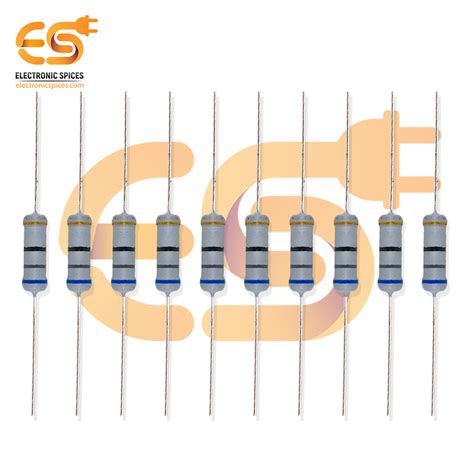
Resistors are fundamental passive electronic components, crucial for controlling current flow and distributing voltage within a circuit. As a cornerstone of electronics, understanding their specifications, functions, and applications is essential for anyone delving into circuit design or repair.
This article will specifically explore the characteristics and applications of a 68 Ohm 2 Watt resistor, providing a deep dive into what these values signify and where such a component finds its utility. We will uncover how its resistance and power rating dictate its behavior and suitability in various electronic systems.
What Do "68 Ohm" and "2 Watt" Mean?
The primary value, "68 Ohm," denotes the resistor's electrical resistance. This measurement indicates how much the resistor will oppose the flow of electric current, directly impacting the voltage drop across it according to Ohm's Law (V = IR).
The secondary value, "2 Watt" (2W), refers to the resistor's power rating, which is its maximum capacity to dissipate heat without being damaged. This rating is critical because when current flows through a resistor, electrical energy is converted into heat, and exceeding the power rating can lead to overheating and component failure.
Understanding Resistance (68 Ohms)
A resistance of 68 ohms means that for every volt applied across it, approximately 0.0147 amperes (1/68) of current will flow, assuming it's the only impedance in the path. This specific resistance value falls into a common range suitable for various applications, offering moderate current limiting capabilities.
Engineers select 68 ohms when they need a precise amount of resistance to achieve a specific current, create a voltage division ratio, or set a time constant in RC circuits. Its value makes it versatile for both low-power signaling and moderately higher-power control applications.
Understanding Power Rating (2 Watts)
The 2-watt power rating signifies that this resistor can safely dissipate up to 2 watts of heat continuously. To determine if this rating is sufficient, one must calculate the actual power (P) expected to be dissipated in the circuit using formulas like P = I²R or P = V²/R.
It is generally good practice to select a resistor with a power rating at least twice the calculated power dissipation for safety and longevity, a concept known as "derating." This margin prevents the resistor from operating too close to its thermal limits, improving reliability and extending its lifespan.
Common Types of 2-Watt 68-Ohm Resistors
Resistors with a 2-watt power rating are typically found in slightly larger physical packages compared to common 1/4W or 1/2W resistors. This larger size is necessary to effectively dissipate the increased heat generated.
While carbon film and metal film resistors are available in 2W ratings, wirewound resistors are also common for these higher power applications due to their excellent heat dissipation characteristics and robustness. Each type offers different advantages in terms of precision, temperature stability, and cost, influencing the designer's choice.
Read Also: Component Lathes And Functions
Practical Applications and Use Cases
A 68 Ohm 2 Watt resistor finds its utility in circuits where moderate current limiting or voltage dropping is required, along with the capacity to handle a fair amount of power. Its robust power rating makes it suitable for more demanding applications than standard low-power resistors.
One common application involves current limiting for higher-power LEDs or in driver circuits where a significant voltage drop is needed to set the operating current. It can also be used in audio amplifier feedback networks, power supply snubber circuits, or as a load resistor in specific testing scenarios.
Current Limiting and Voltage Division
In power supply circuits, a 68 Ohm 2 Watt resistor might be used in voltage divider networks that require a component capable of handling considerable current. This ensures stable voltage references even under varying load conditions, making it a reliable choice for such critical roles.
For applications like motor control or switching inductive loads, this resistor can act as part of a protective circuit, dissipating energy to prevent voltage spikes. Its combination of resistance and power rating is often ideal for these types of robust protective functions.
Key Considerations for Resistor Selection
When selecting any resistor, beyond its resistance and power rating, other factors like tolerance, temperature coefficient, and physical size play a crucial role. Tolerance defines the permissible variation from the stated resistance value, while the temperature coefficient describes how resistance changes with temperature fluctuations.
For a 68 Ohm 2 Watt resistor, ensuring that its physical dimensions fit the PCB layout and that its temperature coefficient meets the circuit's stability requirements are vital. Always consider the environmental conditions under which the circuit will operate to make an informed component choice.
Installation Tips and Safety Precautions
When installing a 2-watt resistor, ensure adequate air circulation around the component to aid in heat dissipation. Avoid placing it in confined spaces or directly touching other heat-sensitive components, as localized heating can affect overall circuit performance and reliability.
Proper soldering techniques are also important; excessive heat during soldering can temporarily alter resistance or damage the resistor. Always verify component values with a multimeter before final installation, ensuring that the correct 68 Ohm 2 Watt resistor is used as intended by the circuit design.
Conclusion
The 68 Ohm 2 Watt resistor is a versatile and robust component, offering a specific balance of resistance and power handling capabilities. Understanding its specifications and potential applications is key to successful and reliable electronic design, especially when dealing with circuits that require more than just basic current control.
By carefully considering its resistance, power rating, and other characteristics, engineers and hobbyists can effectively integrate this component into a wide range of electronic projects, ensuring stable operation and long-term performance. Its role underscores the intricate interplay of specifications that define every electronic component's utility.
