....
.
...
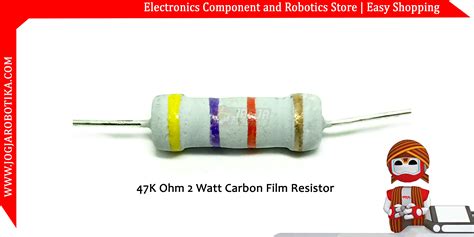
The 47 ohm 2 watt resistor stands as a fundamental component in numerous electronic circuits, playing a vital role in controlling current and managing power. Understanding its specific characteristics is crucial for any electronics enthusiast or professional designing reliable systems.
This article will delve into what makes this particular resistor specification important, exploring its resistance value, power handling capabilities, and typical applications across various electronic designs.
What is a Resistor? Understanding the Basics
Resistors are passive two-terminal electrical components that implement electrical resistance as a circuit element. They are designed to oppose the flow of electric current, thereby regulating voltage levels and protecting other sensitive components.
As covered in broader discussions like our Jan 4, 2026 article on resistors, their primary functions include current limiting, voltage division, and heat generation in specific applications.
Decoding "47 Ohm": The Resistance Value
The “47 ohm” designation indicates the resistor's nominal electrical resistance, measured in ohms (Ω). This value determines how much the resistor will impede the flow of current within a circuit.
According to Ohm's Law (V=IR), for a given voltage, a 47-ohm resistor will allow a specific amount of current to pass through it, making it suitable for particular current-limiting or voltage-dropping tasks.
Decoding "2 Watt": The Power Rating
The “2 watt” (2W) rating signifies the maximum amount of power that the resistor can safely dissipate as heat without being damaged. This power rating is a critical parameter, especially in circuits handling higher current levels or significant voltage drops.
Exceeding a resistor's power rating will cause it to overheat, potentially leading to its failure or even damage to surrounding components in the circuit.
Why 47 Ohms with a 2-Watt Rating?
Combining a 47-ohm resistance with a 2-watt power rating suggests its suitability for applications where moderate current needs to be limited and where the power dissipated by the resistor might be substantial. This specific combination is often found in various power control and signal conditioning stages.
For example, if 0.2 amps of current flow through a 47-ohm resistor, the power dissipated would be P = I²R = (0.2A)² * 47Ω = 0.04 * 47 = 1.88 Watts, which is just under the 2-watt limit, making this resistor an appropriate choice for such a scenario.
Read Also: Mio Soul GT Cylinder Block Guide: Symptoms, Replacement, and Maintenance
Common Types and Construction for 2-Watt Resistors
Resistors with higher power ratings like 2 watts are typically constructed using materials and designs that can handle more heat efficiently. Common types include metal oxide film, wirewound, or sometimes carbon composition resistors.
Wirewound resistors, for instance, are often chosen for their high power dissipation capabilities and stability, while metal oxide film resistors offer excellent stability and a broad range of resistance values.
Practical Applications of the 47 Ohm 2 Watt Resistor
The 47 ohm 2 watt resistor finds its place in a diverse range of electronic applications. It is frequently used in power supply circuits to limit inrush current or discharge capacitors, ensuring stable operation.
Furthermore, it is common in audio amplifier circuits, motor control systems, and various industrial control applications where robust current regulation and heat management are essential for reliable performance.
Key Considerations for Circuit Designers
When incorporating a 47 ohm 2 watt resistor, designers must also consider its tolerance, which indicates the permissible variation from its nominal resistance value. Temperature coefficient is another vital factor, describing how the resistance changes with temperature fluctuations.
Physical size and mounting options are also important, especially in compact designs where heat dissipation needs to be managed effectively to prevent thermal issues within the enclosure.
Ensuring Longevity and Performance
Proper selection and application of a 47 ohm 2 watt resistor directly contribute to the longevity and reliability of an electronic device. Always ensure that the actual power dissipated during operation stays well within the resistor’s specified power rating.
Additionally, providing adequate ventilation or heat sinking for higher power resistors can significantly extend their lifespan and prevent premature component failure.
Conclusion
The 47 ohm 2 watt resistor is far more than just a simple electrical component; it is a critical building block in countless electronic systems, offering precise current control and robust power handling. Its specific values make it an indispensable part of designs ranging from consumer electronics to industrial machinery.
Understanding the interplay between its resistance and power rating is key to designing efficient, reliable, and durable electronic circuits that perform as intended under various operating conditions.
